Software factory
The quality loop for your software factory
Plug monoscope into the coding agents you already run so they read production before they write code. Or let it run its own loop: watch production, find what to fix, open the pull request.
01 · Your factory
Plug into the agents you already run
Claude Code, Cursor, Codex, Warp or an agent you wrote yourself: point it at the hosted MCP server and it can search the requests, logs, traces and issues behind the code it's about to change. Same API key as the CLI and the REST API.
mcpServers · Claude Code, Cursor and any client that reads this shape
{
  "mcpServers": {
    "monoscope": {
      "url": "https://api.monoscope.tech/api/v1/mcp",
      "headers": {
        "Authorization": "Bearer YOUR_API_KEY"
      }
    }
  }
}
-
Hosted MCP server
Every public API operation is a tool, plus analyze_issue, find_error_patterns and search_events_nl. Nothing to install or keep running.
-
A CLI for shells and CI
One binary. Piped output switches to JSON with a stable shape, so agents and CI jobs parse the same thing every time.
-
Skills for Claude Code
investigate, triage, manage, instrument and kql-reference turn a plain question into the right CLI calls.

02 · Its own loop
Watches production and opens the pull request
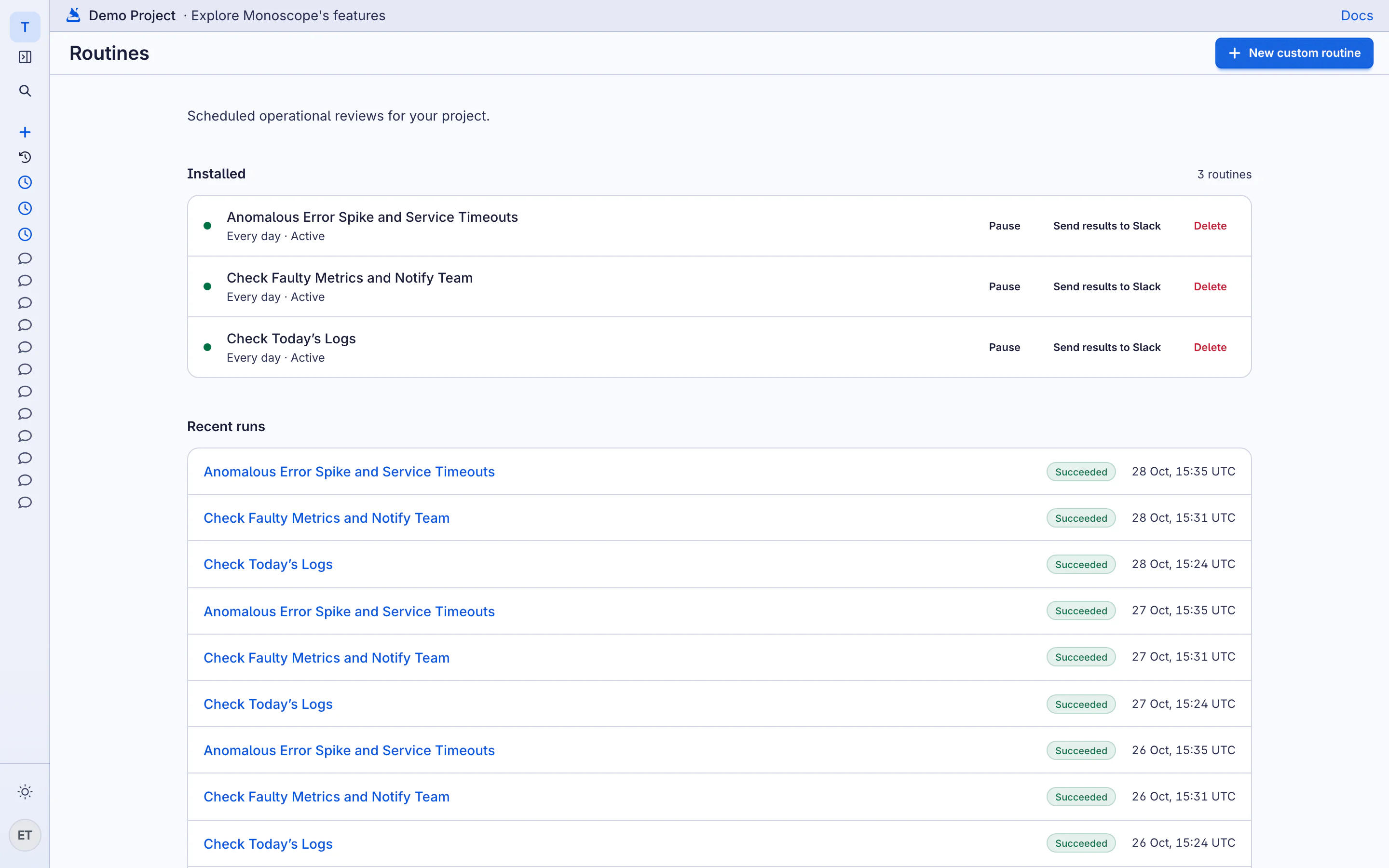
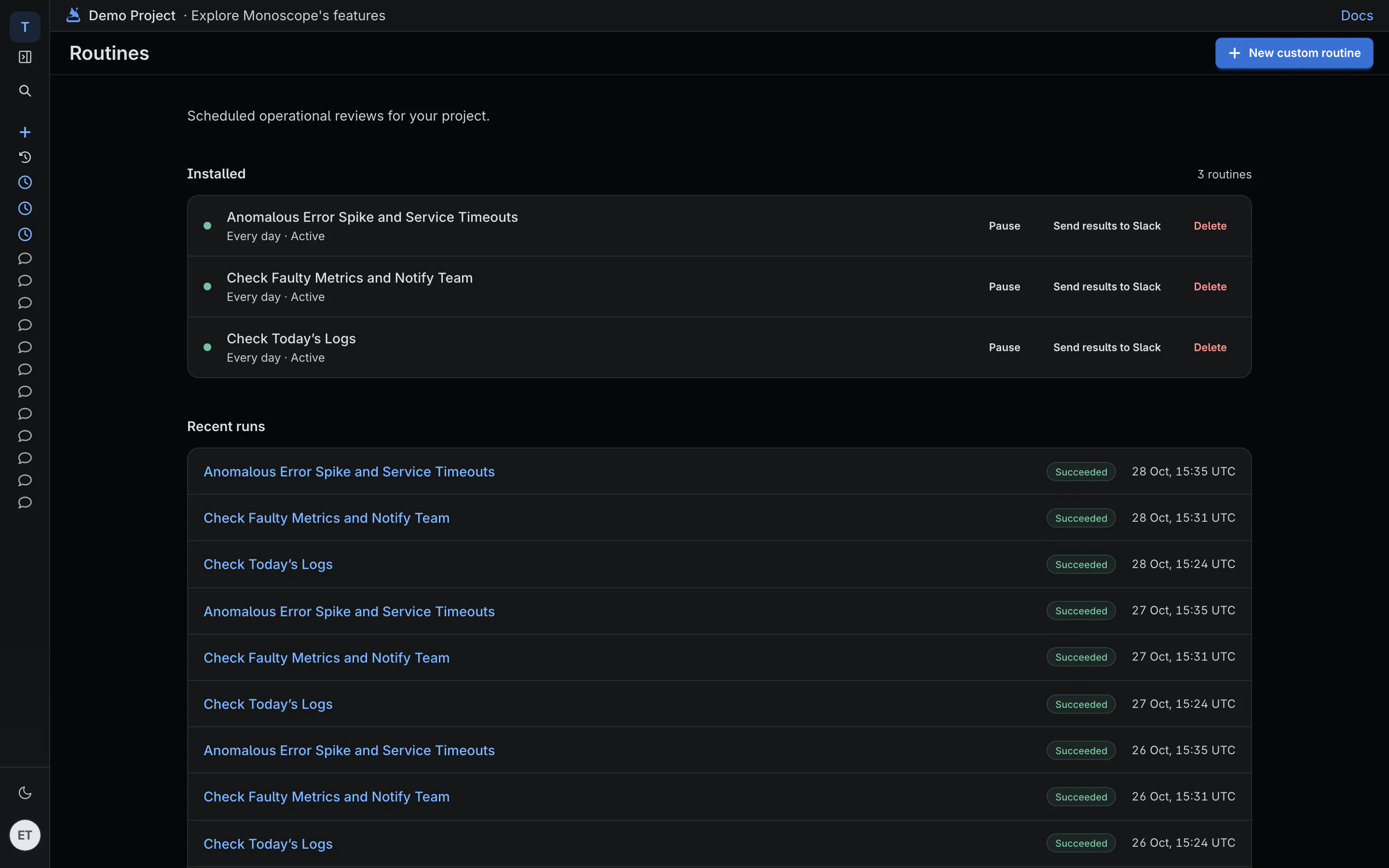
Routines run on the schedule you set and check performance, errors, telemetry and deploys. When one finds something worth changing, monoscope writes the change against your repository and opens a draft pull request with the requests that justify it.
-
Slow endpoints
Slow endpoint watch runs every hour and names the endpoints that got slower, with the traces behind them.
-
Errors that came back
Error regression radar flags errors that returned or grew, grouped into one issue per problem.
-
Every new version
Deployment regression review compares errors and latency before and after each service version, every afternoon.
-
Gaps in your telemetry
Telemetry gap detector finds services that stopped sending logs, traces or metrics.
03 · What users ask for
Builds what your users ask for
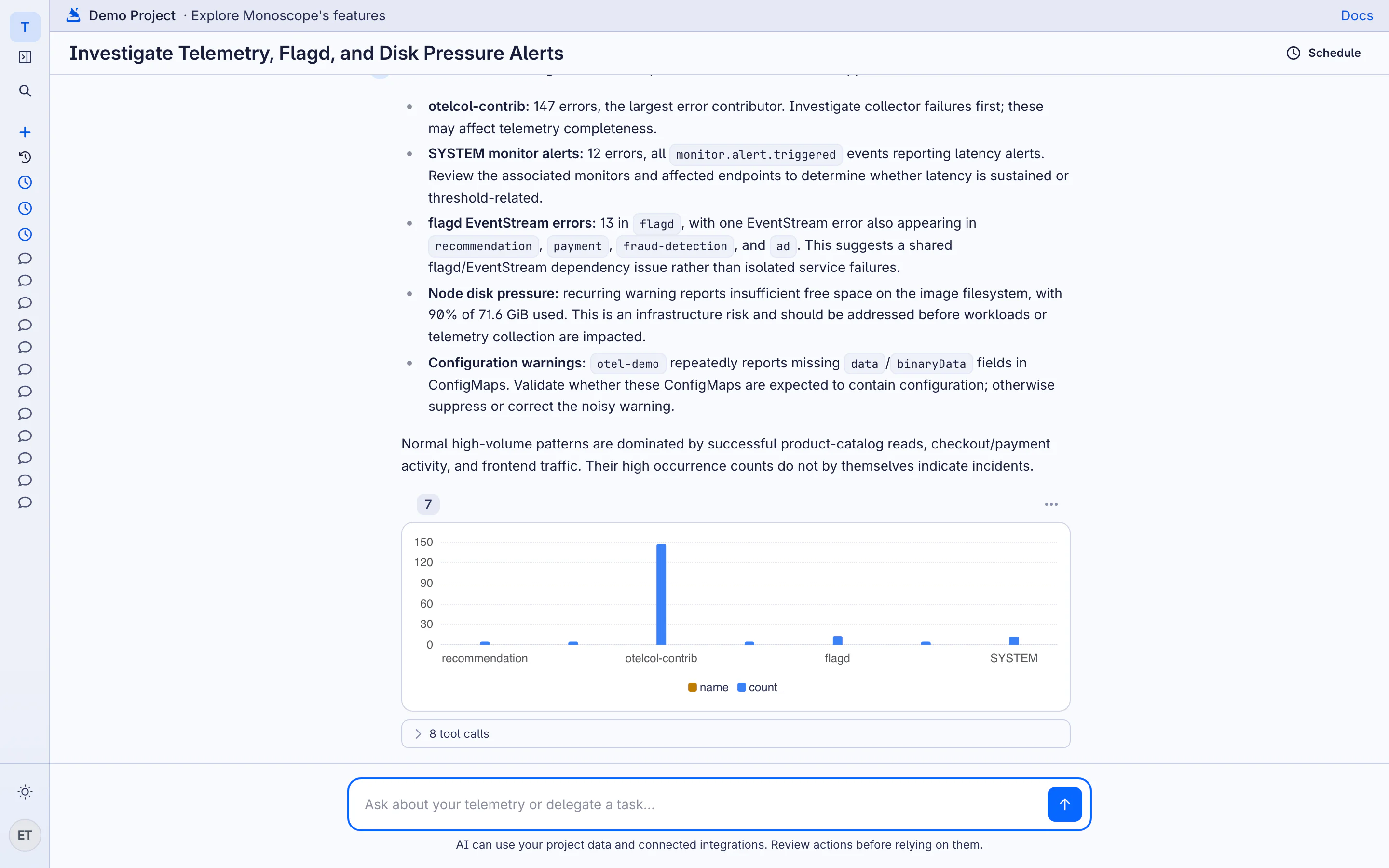
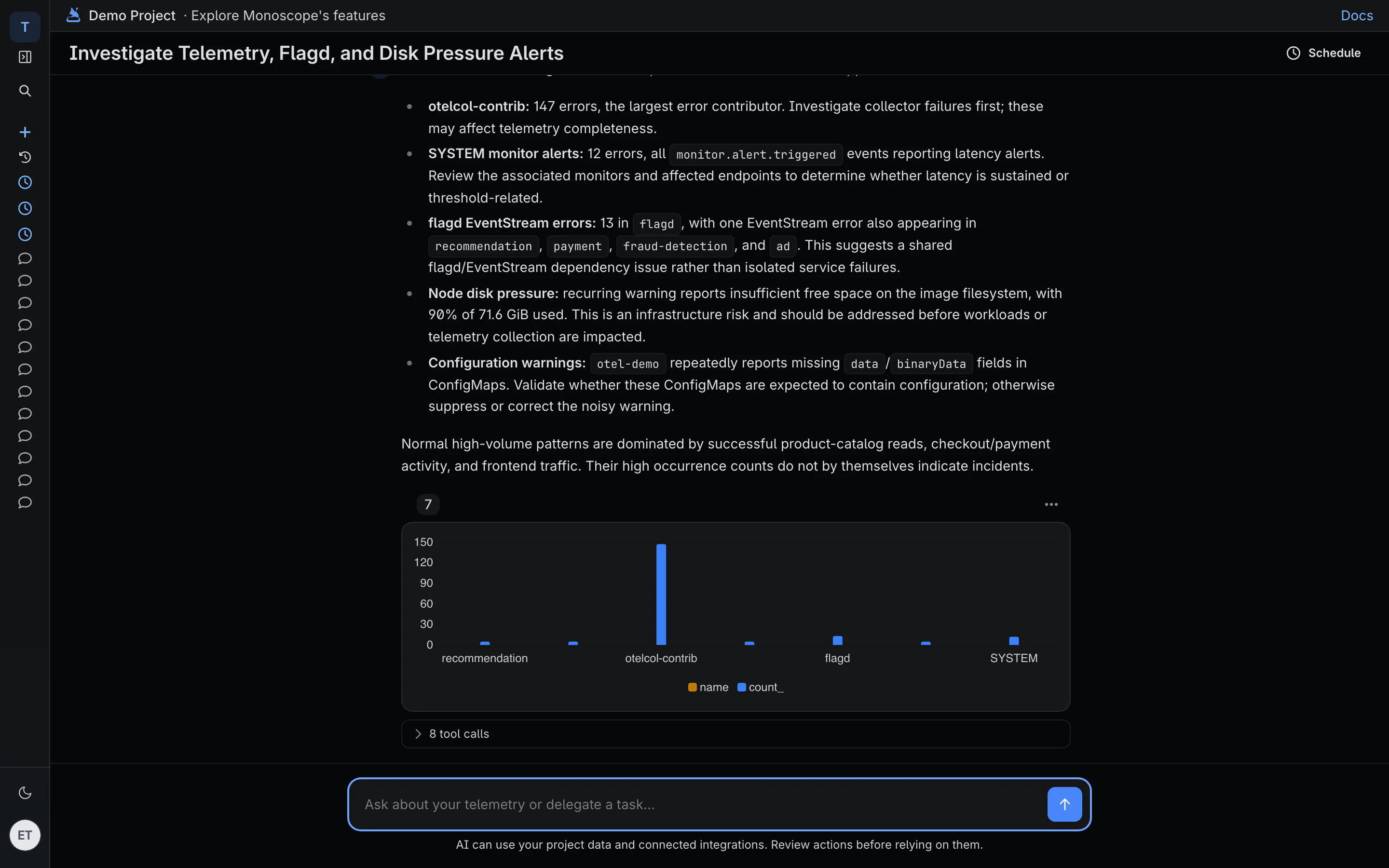
Ask for a feature in Slack or in the app, and monoscope turns it into implementation work on your repository: it reads the code at the deployed commit, checks how the affected endpoints are used in production, and opens a pull request for your review.
-
From Slack or the app
Ask in a channel thread or the AI chat. Follow-up questions keep the context of the request.
-
Sized against real traffic
It looks up the requests that hit the code it's changing, so the plan matches how the endpoint is used.
-
Feedback becomes issues
Feedback your users send from inside your product lands as an issue, next to the requests around it.
04 · Before it merges
Every pull request, checked against production
Whoever wrote it, a person, your agent or monoscope, each open pull request gets a comment with what live traffic says about the lines it changes: how many requests hit them, how many failed, and what to check before merging.
-
Tied to the changed lines
Findings point at a file and line in the diff, with event and error counts from production.
-
Says when it can't tell
If the changed code has no traffic yet, the verdict says coverage unknown.
-
Advisory, per repository
Reviews never block a merge. Turn them on per repository with the GitHub App.
05 · Feedback
Learns from what your team tells it
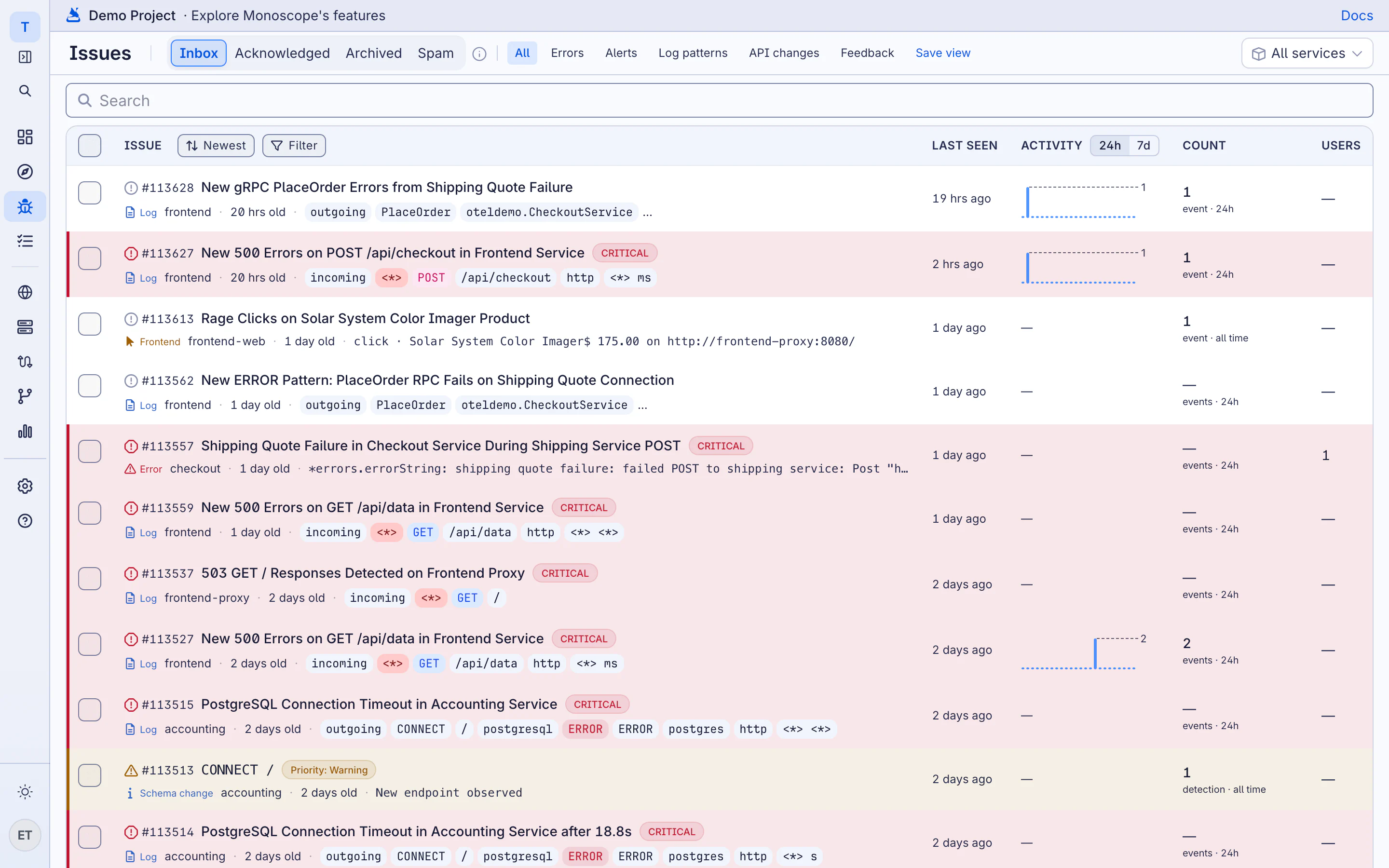
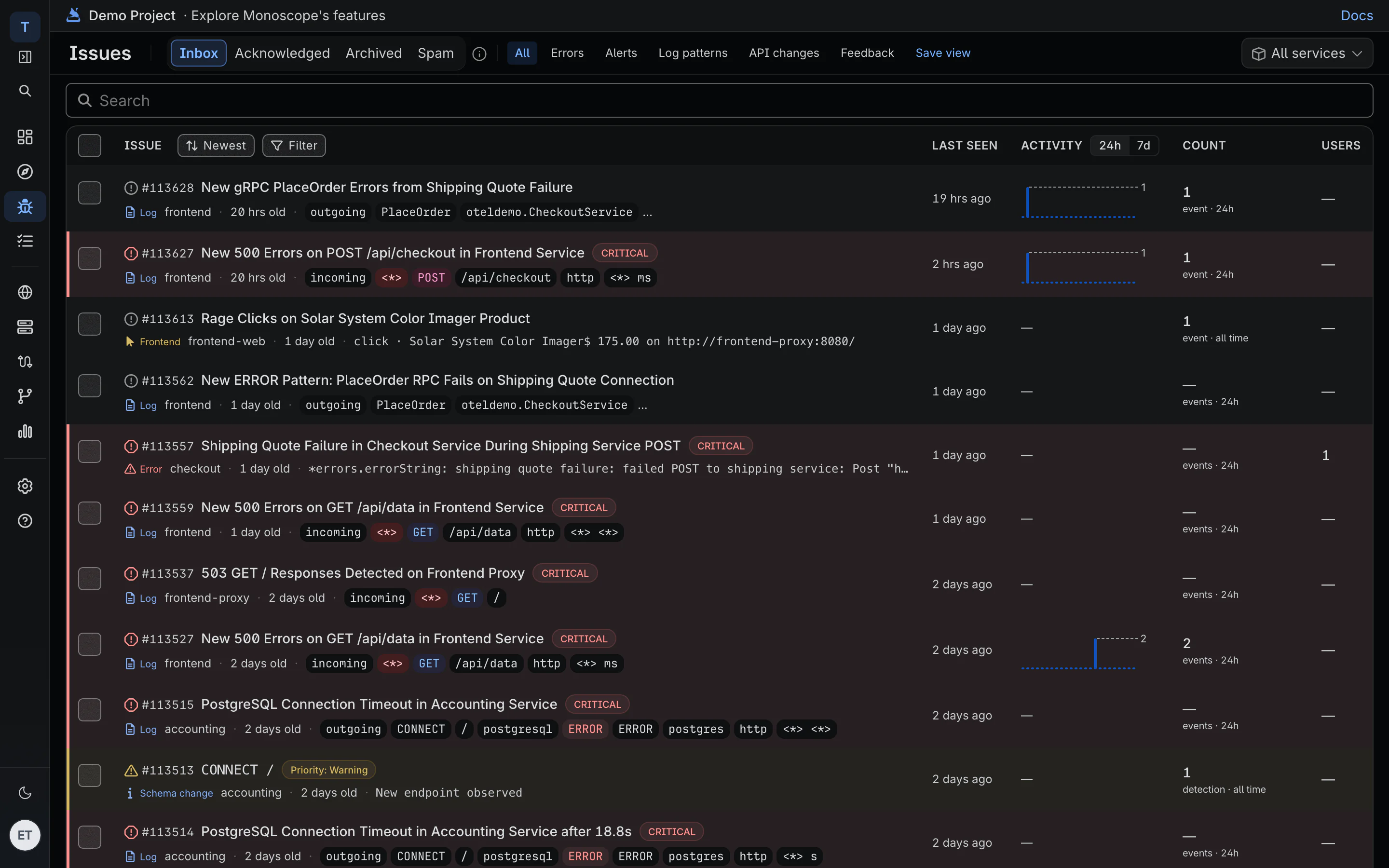
Replies in Slack, comments on its pull requests and corrections in the app go into a memory kept per project. The next investigation, routine or pull request starts from what your team already said.
-
One memory per project
What it learns stays with the project, not with one chat thread.
-
From every channel
Slack threads, GitHub reviews and the AI chat all feed the same memory.
-
Your coding agents read it too
Agents connected over MCP or the CLI get the same project context monoscope uses.
Questions
What do you mean by a software factory?
A setup where coding agents write, test and open pull requests, and people review what ships. monoscope fits in two ways: it gives your agents production data, and it runs its own loop from production to pull request.
Does it merge or deploy anything on its own?
No. Its pull requests are drafts and its reviews are comments. Your reviewers and your CI decide what merges and ships.
Do I have to replace the coding agents we use?
No. Keep Claude Code, Cursor, Codex or your own agents. Connect them over MCP or the CLI with a project API key, and they query the same data monoscope's AI does.
What production data do the agents see?
Logs, traces, metrics, issues, deploys and, with our SDKs, the request and response bodies of your API calls and the calls you make to suppliers, unsampled on paid plans.
Can it read our code?
Only repositories you link. It reads source at the commit that was deployed, so its changes and reviews match the code that ran.