

API monitoring
API monitoring for what you sent and what they answered
Every request and response, the ones customers send you and the ones you send suppliers, kept with full bodies. When a field changes, you know first. When a partner disputes it, you show them.
01 · In and out
Your endpoints and your suppliers', side by side
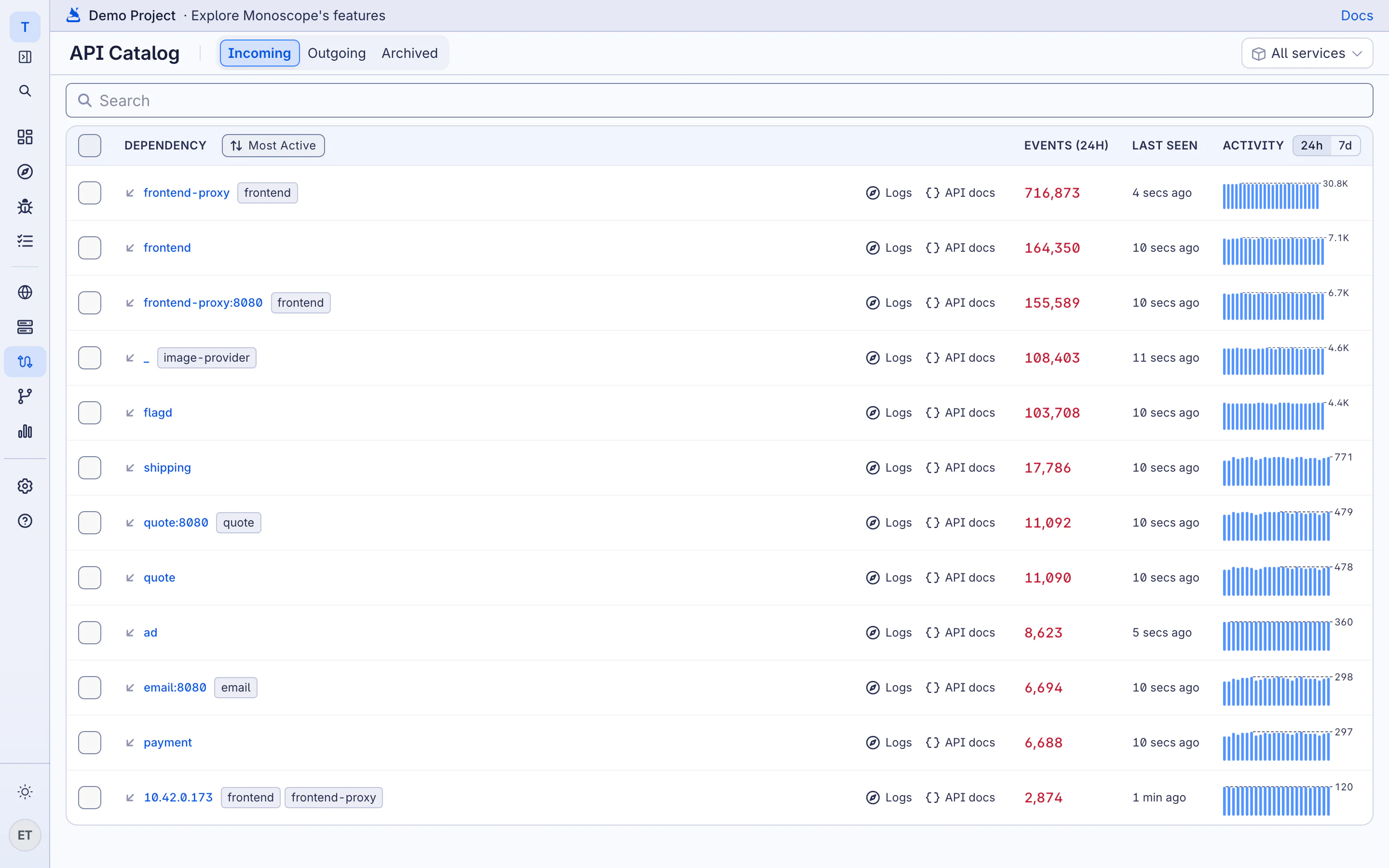
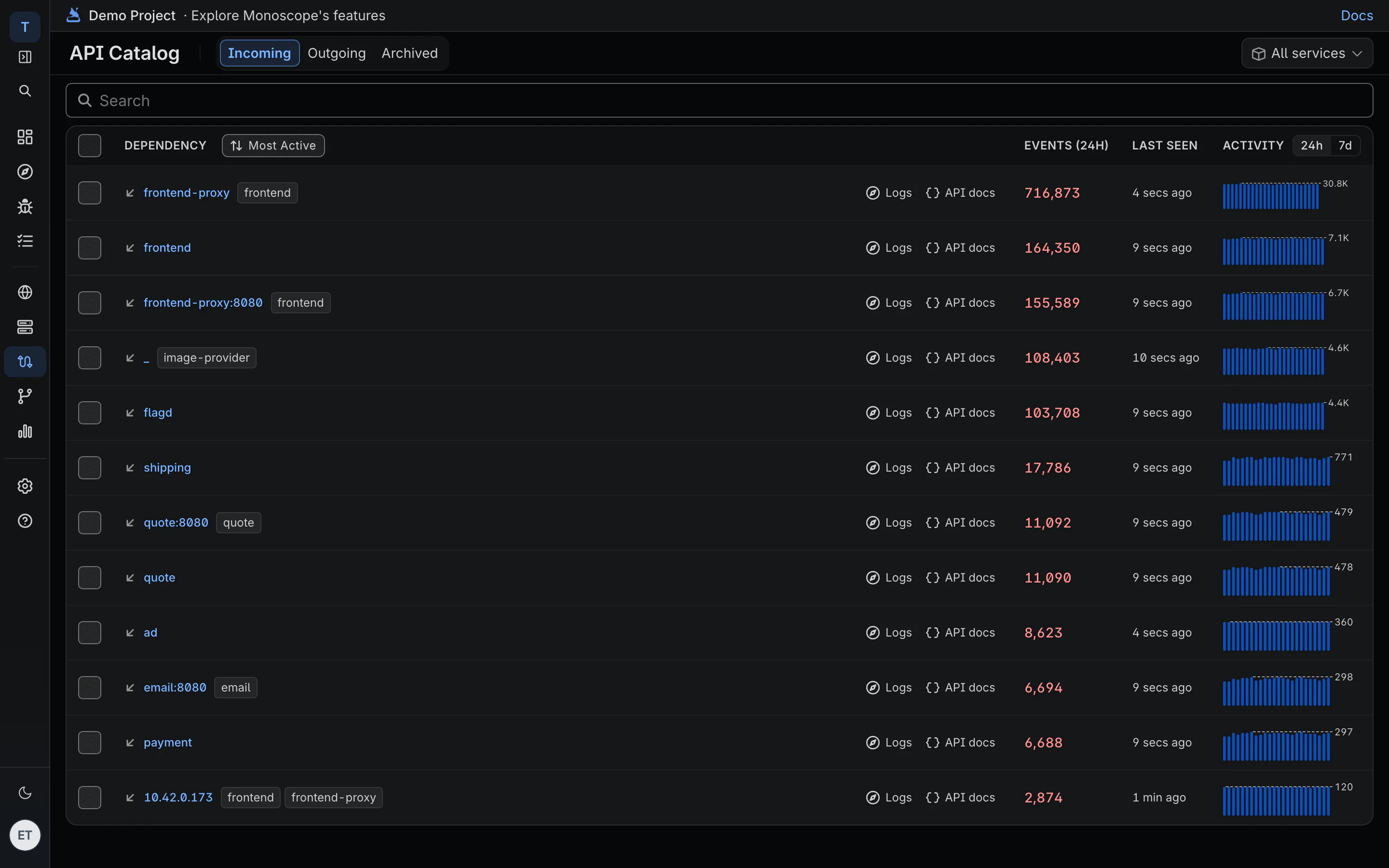
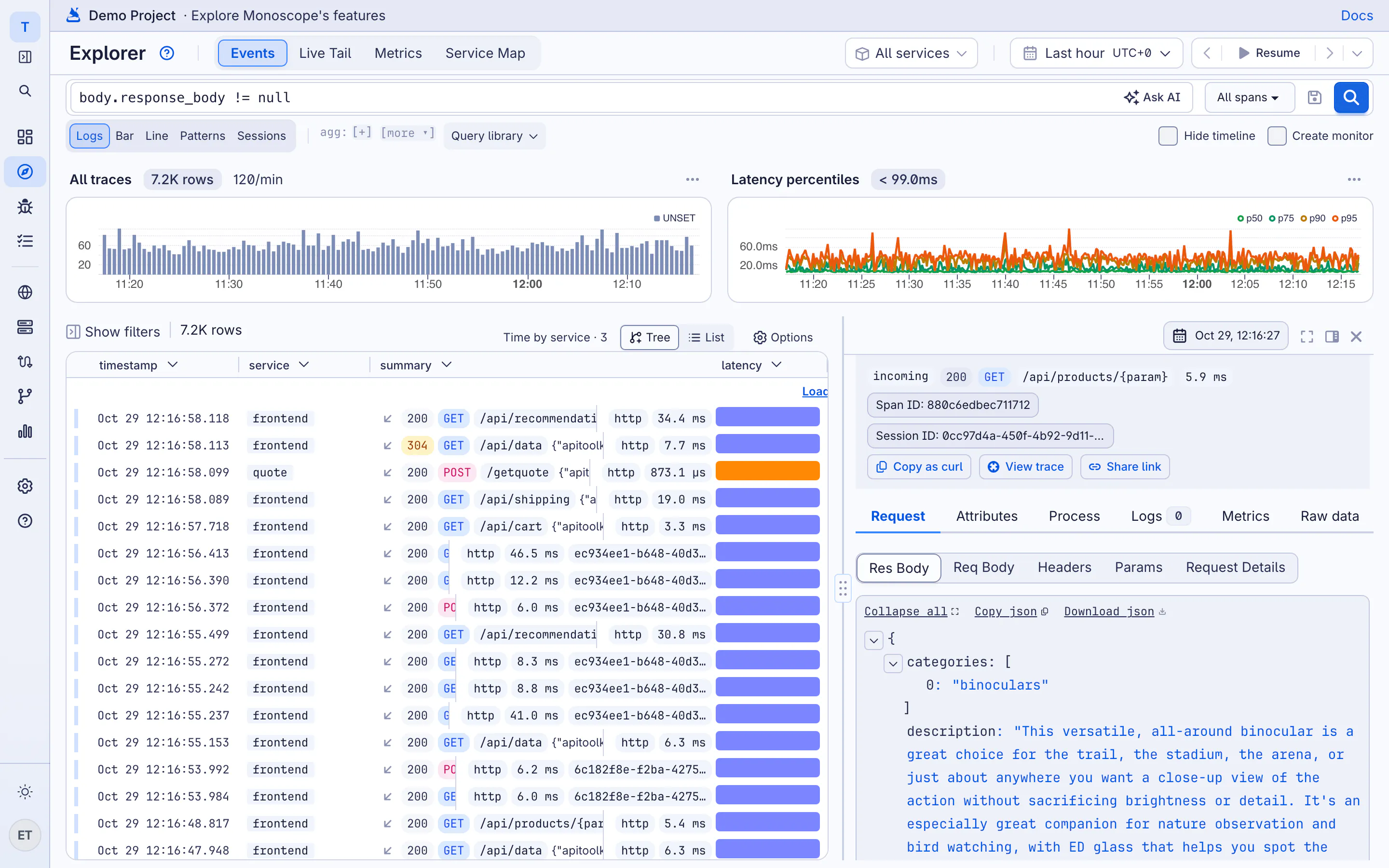
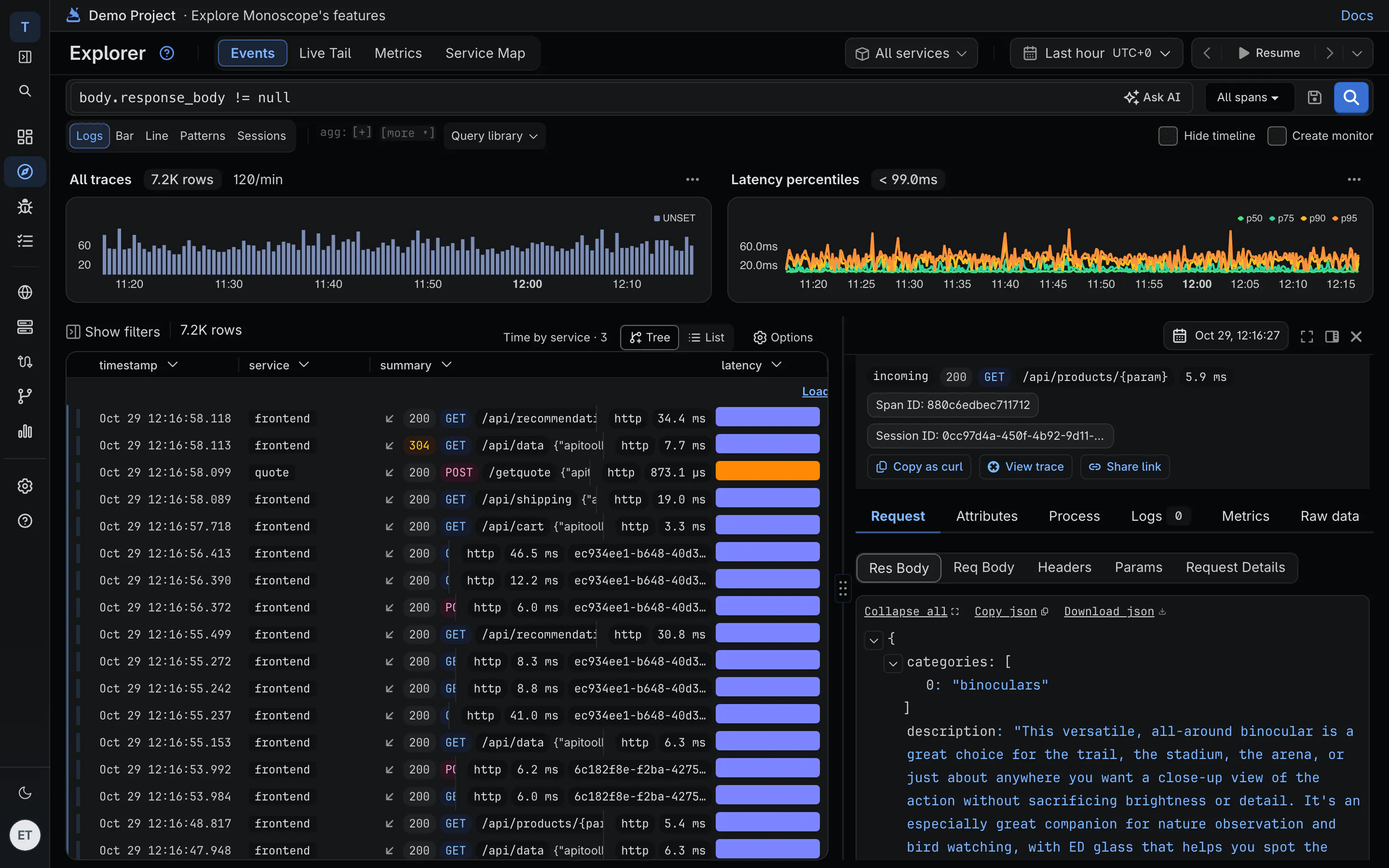
Most API monitoring stops at your own routes. monoscope also records the calls your app makes to payment providers, logistics partners and KYC vendors, with the request you sent and the response they returned.
-
A catalog built from traffic
Every endpoint you serve, grouped by host and service, with its fields, latency and error rate. Nothing to declare up front.
-
Every host you call
Outgoing hosts get the same catalog: which services call them, how often, how slowly, and how often they fail.
-
Full bodies, every call
Headers, request body and response body for each call, linked to the trace and logs around it. Bodies don't add to the price.
02 · Breaking changes
Know when an API changes shape, before customers do
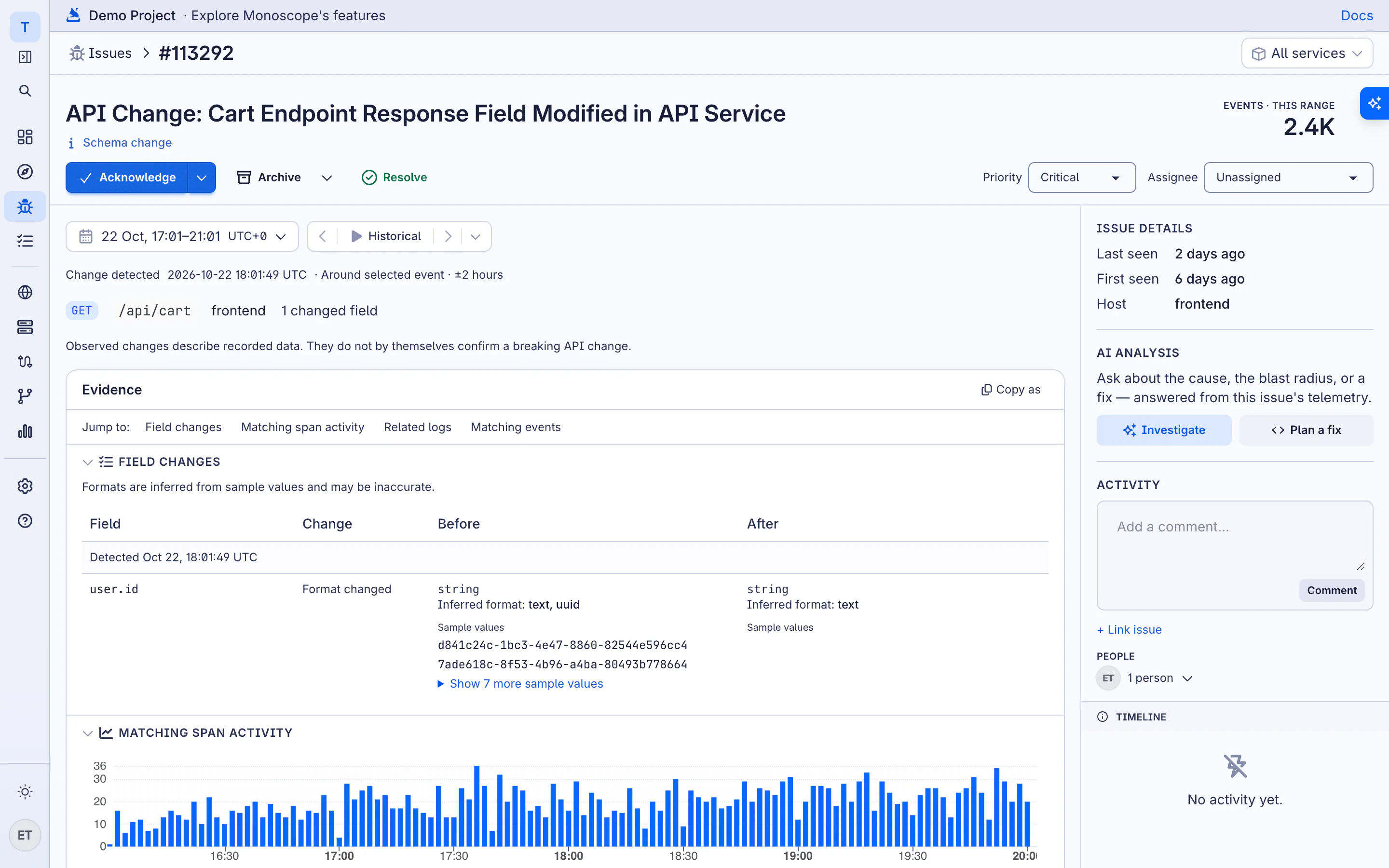
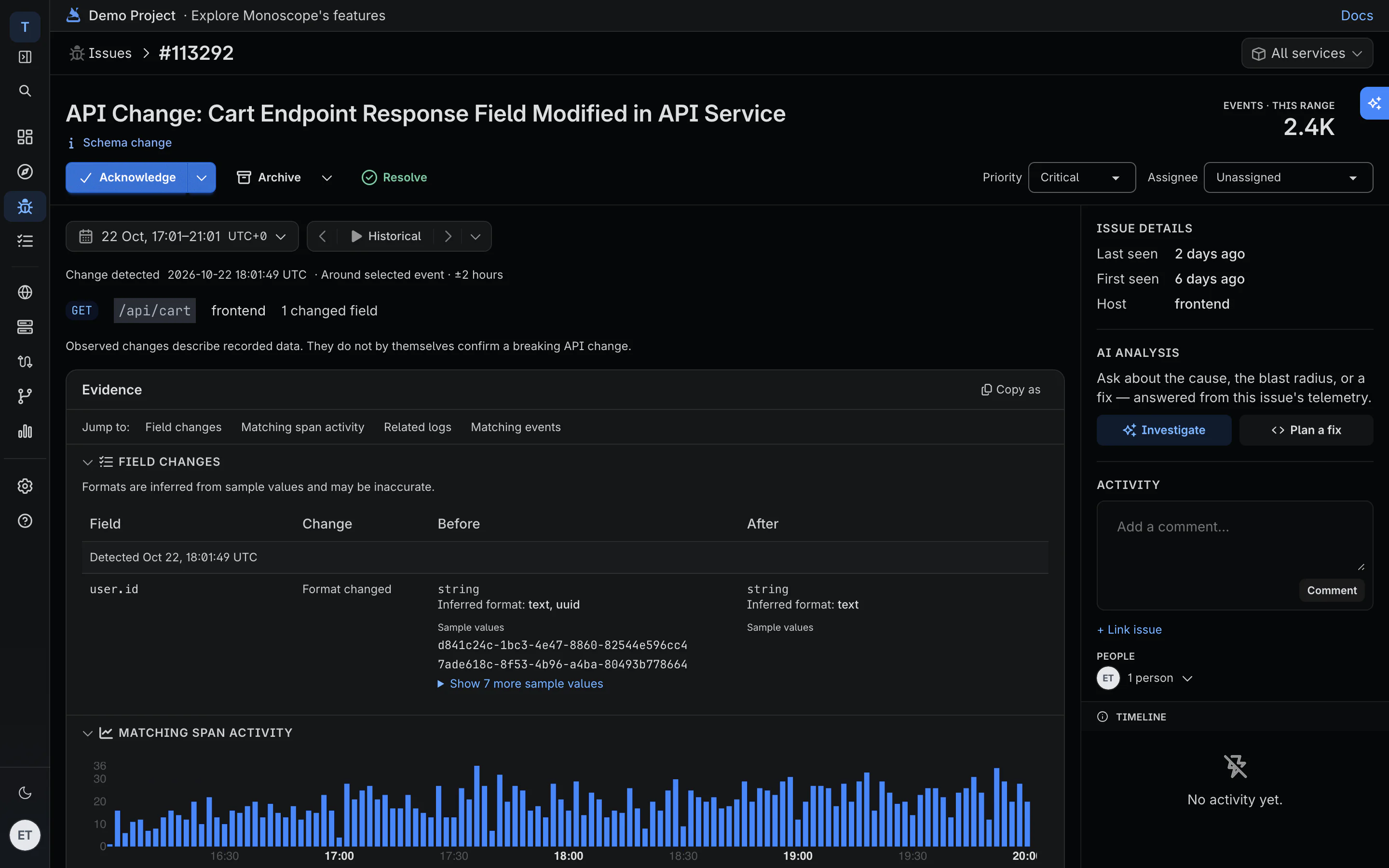
A supplier drops tracking_id. Its API still returns 200 OK, nothing throws and the traces stay green. monoscope compares each response with the shape it learned, and flags the missing field with the requests that show it.
-
Fields added, removed or retyped
Each change names the field path, the old type and the new one, and is rated breaking, incremental or safe.
-
In APIs you don't own
The same check runs on supplier responses, so their change reaches you as an issue the first time a response shows it.
-
New endpoints and formats
A route nobody documented, or a field that switched from a number to a string, shows up the first time it's seen.
-
Your own deploys too
A deploy that renames a field your mobile app still reads is caught in the response, before the app store reviews do.
03 · The receipt
When someone disputes it, show them the request
One customer took a supplier to court. The supplier had acknowledged every request with a 200 and never did the work. The stored requests, with what was sent and what came back to the millisecond, were the case.
duckdb · every call to a supplier on one day, from your bucket
INSTALL delta; LOAD delta;

SELECT timestamp,
       attributes___http___request___method       AS method,
       attributes___url___full                    AS url,
       attributes___http___response___status_code AS status
FROM delta_scan('s3://your-bucket/timefusion/otel_logs_and_spans')
WHERE project_id = 'your-project'
  AND date = DATE '2026-09-27'
  AND attributes___server___address = 'api.supplier.com'
ORDER BY timestamp;
-
Support names the partner
"Our tech support could see via APItoolkit which third-party integration partner was responsible." Joshua Chinemezum, CEO of Platnova.
-
Share the exact call
Send a partner a link to the request and response instead of describing them. Anyone with the link can view it for 48 hours.
-
Keep it as long as you need
30 days on Cloud. Add your own S3 bucket ($199/month) for unlimited retention in open Delta Lake and Parquet.
Questions
How do outgoing calls get recorded?
Our SDKs wrap the HTTP clients your app uses, such as Axios in Node.js, and record each call with its request and response. Plain OpenTelemetry records the call as a span, without the bodies.
Do request bodies cost extra?
No. A request counts as one event whatever its size. Free up to 10k events a day, then $29 a month for 20M events and $1 per million after.
What about sensitive fields?
List headers and JSON paths such as $.card.number in the SDK config. They're redacted in your app before anything is sent.
How long are requests kept?
30 days on Cloud. With your own S3 bucket, as long as you keep the bucket, in open Delta Lake and Parquet you can query with DuckDB or Postgres-compatible SQL.
Can it monitor third-party APIs and webhooks we depend on?
Yes, for calls your app makes: our SDKs record each outgoing call with its request and response, and flag a supplier response that changes shape. Incoming webhooks are requests to your API, so they're recorded like any other.
Does this replace Treblle or an API gateway's analytics?
It covers the API side and adds the rest: logs, traces, metrics, session replay and an AI that investigates from the stored requests. Gateways see calls coming in, not the calls your app makes out.